Sunday, May 17, 2009

Specialized Defroster Shoes

This fall I finally made the plunge and purchased a pair of winter mountain bike shoes. Okay, actually my mom bought them for me, but I picked them out, and I would have paid for them if my mom wasn't feeling generous.


My original idea was that I would use these next year, a typical end-of-season sale purchase waiting for the next season to be used. But as you can see, springtime in Vermont has plenty of opportunities for a pair of shoes designed to ridden in cold, wet conditions.
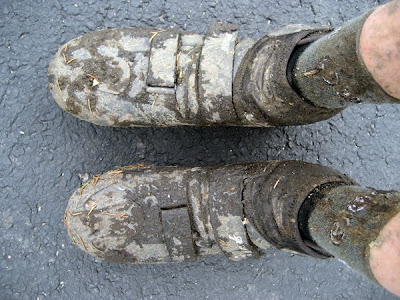

These shoes are a lot like my regular mountain bike shoes, which are also made by Specialized. Like regular higher-end cycling shoes, they have a solid heel cup and toe protection. Unlike regular mountain bike shoes, these shoes are insulated instead of ventilated. They have dual velcro straps and a neoprene cuff that seals off your ankle. Although they don't have a ratcheting system to tighten down the straps, I have found that the velcro alone works well enough for my performance needs.


The neoprene cuffs effectively keep dirt and mud out. Like most mountain bike shoes, these have hard plastic soles that are designed to provide traction in mud.


I have put these through some pretty gnarly rides, including several that required me to wade through a fair amount of muck. On numerous occasions I have stepped into some pretty deep and cold river beds, and to my surprise, they actually are waterproof.

When I saw this promise on the outside of these shoes, I assumed it was too good to be true. "Sure, waterproof like all the crappy raingear I have owned over the years" was what I was thinking. Well, turns out they are really waterproof. Step into a puddle, and unless you go in over your ankle, no water gets in. I am impressed, and it is hard to express how much more pleasant it is to ride in shoes that are not soggy and squishing like an old sponge.


While these are waterproof they certainly are not breathable. I've found even with my nicer raingear that there's really no way to totally eliminate the trade-off between waterproofing and breathability. On a couple of rides that have taken place on the warmest of Vermont spring days, my feet have gotten wet from the inside, although I have to say that the temperature range of these shoes is quite a bit broader than I expected. Wearing a thin summer sock, using these when it's about 70 degrees F (21 degrees C) seems fine.

I have ridden when is about 20 degrees F (-7 degrees C) and although my feet did not freeze I would say that this is at or below the lower limit for these shoes. Sock selection makes a big difference, and I suppose that with the right thin-but-hearty wool sock you might survive a bit colder. In windy conditions these shoes really shine. There's no sense that the wind is blowing through your toes at all, a welcome lack of discomfort for someone who's been wearing a regular pair of mountain bike shoes way too deep into the fall for years.

After a few months of pretty serious use, these shoes get an enthusiastic endorsement. Now, only their durability remains to be seen.

I am a big fan of Specialized cycling shoes. They are well-constructed, well-designed, and about as aesthetically pleasing as we can expect bikes shoes to be. My foot, which is on the narrow size, seems to be compatible with Specialized's "Body Geometry" design. Your foot might not be so friendly with this design, so definitely try these on in the store before you make the plunge.

Titec H-Bar designed by Jeff Jones

The newest incarnation of the Karate Monkey came about when I got a new 29er cross-country frame (a Titus Racer-X, to be described later). Originally single speed and then converted to a geared hardtail, the KM is once again back as a fully-rigid, single speed bike. It's become my "Vermont bike", and in cobbling it together from the parts that came of my geared cross-country bike, I needed to get a pair of handlebars.

I have had my eyes on Jeff Jones' distinctive handlebars since they came out and were only three hundred dollars; now these titanium conundrums are up to five hundred dollars. Five hundred dollars for handlebars? Now don't get me wrong, I am all in favor of saving up for quality bike gear, but to drop that much on a pair of weird handlebars with a design I have never ridden before seems nuts.

Luckily, Jeff Jones has allowed some of his design innovations to trickle down. Working with Titec, he has created two versions of his H-bars; I have purchased the "riser" type at a price that was comparable to other more conventionally-shaped well-constructed aluminum handlebars.


Because I am running the KM as a single speed, these bars made sense to me. There are a lot of advantages of these bars that are specific to single speeds, which is good because running these on a geared bike limits your options. If you run this bar without gear shifters, all you need to do is throw on your favorite pair of brake levers and grips and use half a roll of bar tape to finish off the side and center sections. If you want to use gears, you probably are best off using the integrated brake/shifter levers offered by Shimano. I have never used these extensively, so I can't vouch for their utility, but suffice to say that when it comes to shifters I fall more towards the "thumbs up" than the "peace sign" side of the debate. Seems that's the way the wind is blowing these days anyway.


I really thought that it would take awhile to get used to these bars, but it did not. They are incredibly comfortable and intuitive to use. The best "control position", which I use for going downhill and riding through fast technical sections, is with your hands on the grips. Although the brake levers may seem far away, as long as your brakes have good two-finger power all is well. One of the big benefits of this position is that is naturally places your weight further back on the bike, the safest position to be in when flying along.


The most important positioned offered by these bars is doesn't look much different from the "on the grips" position, but it is. If you ride a road bike with drop bars and/or are old enough to have seen the golden age of bar ends, this position will feel very intuitive. Placing your thumb through the crook in the bar and enjoying the comfort of the bar wrap that extends the overall grip area, this is the best position for climbing. Unlike conventional bar ends, which are at the widest place on the bar, these bars place your arms further in and your weight further forward, much like a road bike. Winding my way up steep and treacherous climbs in the backwoods of Vermont, I use this position a ton. Riding single speed and doing a lot of standing up, I almost can't remember how I climbed before these bars.


In addition to these two "major positions", the H-bars offer a couple of "minor positions". First, you can grasp the bar extension and brake lightly just above the brake clamp. This position is best when you want to loosen up in an easy section and reconfigure your posture on the bike to save you arms, neck, and back.


The second "minor position" is to rest the heel of your hand on the wrapped "flat" of the bar and grasp the very end of the extension. I use this position the least, but it is a comfortable mode to be in and stretches you out for aerodynamics on flat, windy sections of road. In the woods I don't find myself using these minor positions much, but they make my bike more versatile when dealing with the asphalt that connects the sections of real riding.


What's interesting about these bars is how easy it is to transition on and off of them. Honestly my brain has to work a lot harder to remember how to shift when I switch from my low-normal bike to my high-normal bike than it does when I switch from using these bars to using more conventional risers. For a single speed bike, particularly one that will be ridden in hilly areas, these bars just make a lot of sense.

Although I have seen pictures of Jeff Jones competing in a downhill race using these bars, I would say that for all their comfort they really are best matched to a cross-country bike. The angle of pull is different, but you can get the front end up or do little bunny hops with these bars just like regular risers. However, the inability to roll your wrists forward on jumps and drops would make me hesistant to use these on any bike that sees freeride kinds of terrain.

There's a fair amount of flex in these bars, which is in part due to the great leverage they provide. To be honest this flex is somewhat welcome on my fully-rigid KM, and I never felt a loss of control due to flex.

There are only two true downsides that I can see with these bars.

First is that most people won't be able to adopt them for their multi-geared bike without purchasing dual control brake/shifter units, which are expensive and as mentioned before potentially weird. For those with money to burn, you could consider Jeff Jones' "next generation" titanium H-bars, some of which allow for the placement of both shifters and brake levers. Further showing his commitment to the everyday people, Jeff could allow these designs to trickle down to the Titec line, empowering the multigeared set to alt bar away.

The second downside is that these bars are fixed in width. I found the width to be comfortable, but if you don't there's nothing you can do about it. I have not fully measured them to compare with other bikes, but they are pretty wide. Those who ride in narrow areas should break out the measuring tape before making the commitment to these bars.

Friday, May 15, 2009

Reason #1 = Exploration

Today I went on an amazing ride I've never tackled before. It was an exploration. With a little help from Google Maps and some guesses as to where it would be fun to ride, I was off.

In March, when it was still very much winter, I had managed to explore almost all of the dirt roads that weave in and out of Shrewsbury, VT. But now as I return in May, there's opportunity to go into areas that are the domain of cross-country skis and snowmobiles during the winter.


So I took a ride up the Old Plymouth Road that crosses over from North Shrewsbury to Route 100 between several mountain ranges. The road starts off as a tidy dirt road and then becomes a tidy snowmobile track before completely breaking down into the kind of muddy, rutted, rocky, sloppy road I look for.

It tames out a bit towards the end before dumping you alongside the Bear Creek Ski Club, a small little "exclusive" mountain with a single lift servicing a number of pretty good looking trails. I know it's only because it is nearly summer, but the "ghost town" look of this posh ski club made me feel that perhaps the party's over for the kind of people who can afford to be members of such a club.


Riding along Route 100 is a little boring, especially with an under-geared single speed, but it gave me plenty of time to exercise patience. Moving as slowly as I was, I also had some time to notice something pretty weird:


Perhaps you can't see it clearly from this wider picture, but this is a culvert allowing stormwater to run underneath someone's driveway. It is made of pieces of old marble, one of which is clearly from a gravestone:


Now I am all for recycling, but for the sake of discreetness, wouldn't you at least place this reclaimed rock face down? What's really strange here is that this is not even that old a stone; the former bearer died just over fifty years ago. Is someone robbing gravestones to make culverts? I suspect not, and my guess is that this is not actually someone's gravestone, but a "second" that never made it to the grave it was intended for. Of course I have no real idea of how this stone came to sit in this culvert...

After the flat monotony of Route 100 my reward came as I headed up the Dublin Road and onto Patch Brook Road. Patch Brook Road is this amazingly picturesque dirt road that winds along a glorious river. Roads that follow rivers are often pleasant to follow because in general the paths rivers take are moderate in grade, and the Patch Brook Road is a perfect pitch for my single speed, a gloriously smooth and relaxing climb.


Another aspect I like about the Patch Brook Road is that it used to be paved with asphalt who knows how long ago. Obviously whatever town or county agency is responsible for maintaining it decided that this asphalt was a little unnecessary for a road with no houses on it that connects the back end of two remote areas, so the asphalt was left to disintegrate. There's something very comforting about the way that the forest has reclaimed this road, slowly swallowing up the asphalt until it is almost unnoticeable.


This ride finishes up by Lake Ninevah, where I take my usual roads up and down and back to Shrewsbury. I have been riding this section all week, and every time I get stopped by at least one of the rocky river beds that barely pass for a road. This time, at least twenty-five miles into my ride, I cleared every section.

Interested in trying this ride? It is mapped here:


View Reasons to Ride in a larger map

The Karate Monkey


The Karate Monkey is one of my oldest bikes, and has seen many incarnations. This version is set up fully rigid and single speed, with O.G. quad-piston XT disc brakes and Titec Jones H-Bars.


Housed at my mom's place in Vermont, this is the ultimate back country road bike. There's not really any singletrack in my mom's neck of the woods, but there are plenty of roads that go from paved to dirt to a rocky, muddy mess, and these paths are the favorite of the Karate Monkey. Twenty-nine inch wheels roll through disgusting mud puddles and over large boulders, while the single speed drivetrain cares little for all the grime that comes along with springtime in Vermont. This bike is a lot more fun going up than going down, and I can really use my limited trials skills to slowly pick my way up treacherous roads.

Gearing right now is a comfortable 32x20. This can make flat areas pretty frustrating as it is easy to spin out on this gear, but there really are not too many flat spots around here. There are a couple of roads I would like to tackle that are too steep and messy to tackle in even this gear, but the simplicity and reliability more than make up for the limitations of the single speed.

This bike encourages a mindful riding style: calm, present, and patient. Perfect for the beautiful backcountry of southern Vermont!